


Every parent knows their child in ways no one else does. So when your child covers their ears at a birthday party while everyone else is laughing, refuses to wear certain clothes because the fabric hurts, or melts down after what seemed like a perfectly ordinary school day, you notice. You begin to get worried. And you start to wonder whether what you are seeing is just a passing phase or something that needs attention.
For many children, it is something that does require support. This is often linked to sensory processing challenges, where the brain has difficulty organizing and responding to everyday sensory input. Sensory Processing Disorder is more common than many people realize and can significantly affect a child’s daily functioning and comfort.
Sensory Processing Disorder, or SPD, is a neurological condition in which the brain has difficulty receiving and responding to information that comes through the senses. Most of us process sight, sound, touch, taste, smell, movement, and body position automatically, without much thought. For a child with SPD, that automatic processing breaks down. The brain either over-responds, under-responds, or responds inconsistently to sensory input. A hypersensitive child might find a crowded classroom unbearable. A hyposensitive child, on the other hand, might seek out intense sensory input constantly, never seeming to get enough feedback from the environment. Some children switch between both states depending on the day, the setting, or their overall stress levels.
SPD does not always appear alone. It is frequently seen with autism spectrum disorder, ADHD, developmental delays, and anxiety. But it also occurs in children with no other diagnosis, and it can still significantly affect their ability to learn, play, make friends, and get through daily routines without distress.
When families in Kerala start looking into sensory processing disorder treatment in Kochi, occupational therapy tends to be what specialists point them toward first, and there are good reasons for that. OTs who work with SPD are trained to look closely at how each of the eight senses is functioning, not just the five most people know about. The vestibular system governs balance and movement. The proprioceptive system tells the body where it is in space. Interoception covers internal signals like hunger, temperature, and toileting needs. All of these get assessed. This matters because two children with SPD can look nothing like each other, and a thorough assessment is what makes it possible to build a plan that actually fits.
That plan is not a standard programme pulled off a shelf. It is built specifically around that child, their sensory profile, what is making daily life hard for them, what they are already good at, and how their family's day-to-day life runs.
The primary approach used is Sensory Integration Therapy, developed by Dr A. Jean Ayres. It works by exposing the nervous system to carefully graded sensory experiences in a structured and safe, play-based environment. Over time, the brain learns to process and organise sensory input more effectively, reducing overload and improving regulation.
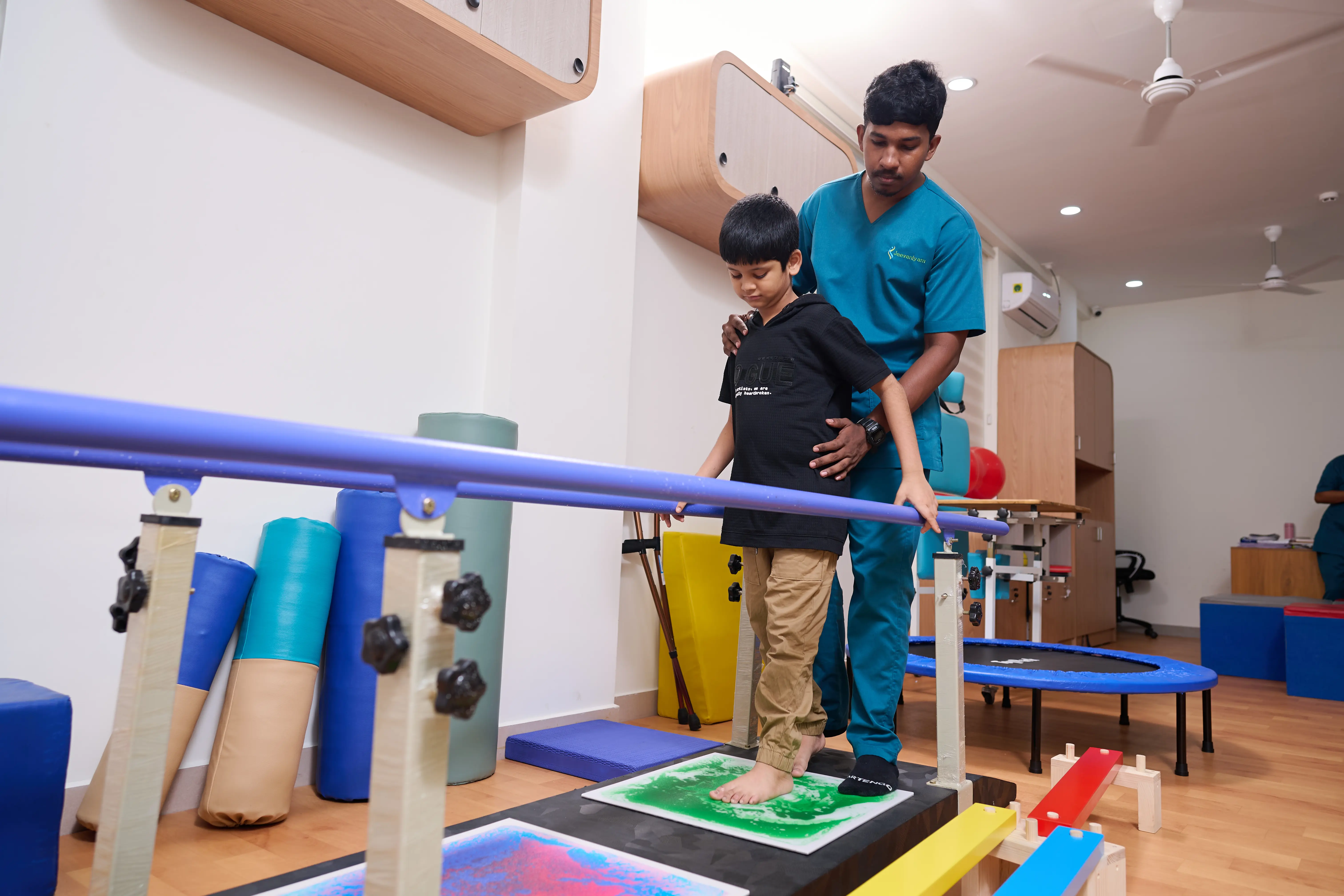
A typical session may include activities such as swinging in a suspended hammock to support vestibular processing, navigating obstacle courses to strengthen proprioceptive awareness, and exploring different textures to reduce tactile defensiveness. The child actively participates and often leads the pace of activities. The occupational therapist continuously observes responses and adjusts the level of challenge in real time to match the child’s sensory needs and regulation capacity.
What happens in the clinic only goes so far. A big part of OT for SPD involves helping families carry that work into ordinary daily life through something called a sensory diet. This is a planned set of sensory activities built into the child's routine at home and at school. It might include a movement activity before the school run, a sensory break mid-homework, or a wind-down routine before bed. What goes into it depends entirely on what that particular child's nervous system needs.
Therapy also works on the practical skills that sensory challenges tend to quietly undermine. Handwriting, getting dressed without a battle, eating something beyond a handful of safe foods, sitting through a school event, and tolerating a haircut without it becoming a crisis. Each of these gets broken into smaller steps and worked on until it stops being so hard for the child and for the whole family.
Parents sometimes wait in the hope that a child will naturally outgrow sensory sensitivities. While some children do improve with age, many with untreated SPD continue to experience difficulties that affect daily functioning. These may include school refusal, anxiety, social withdrawal, and ongoing feelings of being different or misunderstood.
Early occupational therapy intervention, particularly before the age of seven, can be highly beneficial due to the brain’s neuroplasticity. At this stage, the nervous system is more adaptable and able to form new neural pathways more efficiently. While older children can still make meaningful progress, early intervention generally leads to faster and more sustained improvements in regulation, participation, and confidence.
If your child consistently avoids certain textures, sounds, or environments, or actively seeks intense physical input such as crashing, spinning, or squeezing, these may be indicators of sensory processing challenges. Other signs can include significant difficulty with transitions or unexpected changes, struggles with fine motor tasks such as cutting or writing, and frequent emotional outbursts that appear disproportionate to the situation or trigger.
It is important to note that none of these signs alone confirms sensory processing disorder. However, when several of these behaviours appear as a consistent pattern and begin to interfere with daily functioning, learning, or social participation, it is appropriate to seek a professional evaluation from a qualified occupational therapist.
At Jeevaniyam Medipolis, children with sensory processing disorder work with experienced occupational therapists who provide individualised, evidence-based care. The centre runs dedicated sensory integration therapy as part of a wider multidisciplinary team that includes speech therapy, clinical psychology, special education, and Ayurveda, so every part of a child's development gets the attention it needs.
The Sensory Park at Jeevaniyam Medipolis gives children access to therapeutic sensory experiences in a setting built specifically for them. Families are coached and guided throughout so that the progress made in sessions carries through into life at home. For sensory processing disorder treatment in Kerala, schedule a consultation at Jeevaniyam Medipolis to begin a personalized assessment.


 About Us


