


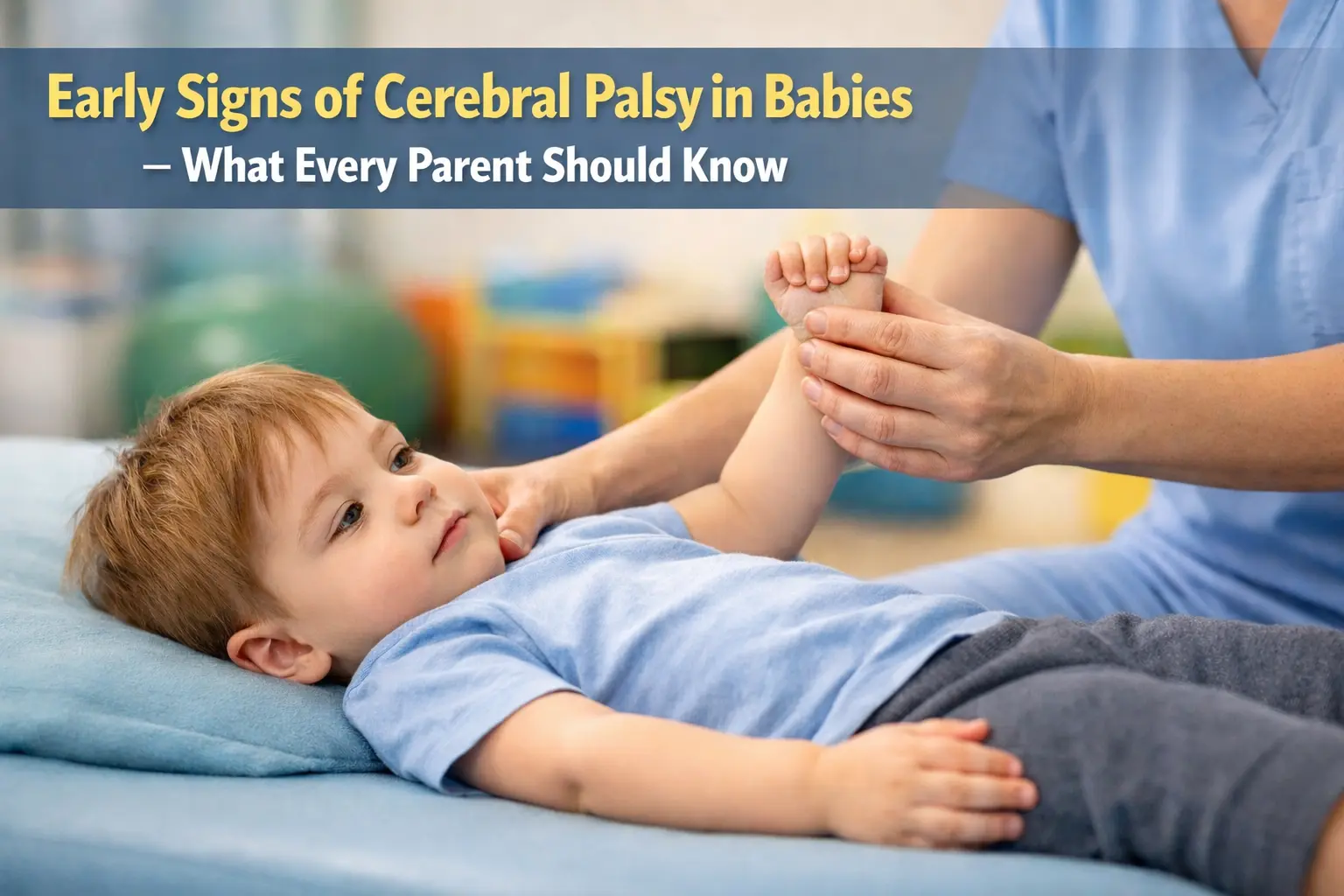
Sometimes, parents notice small things that feel a little different about their baby. It can be as simple as the baby failing to hold their head straight, not responding to sounds, or moving in an unusual way. Such situations may be confusing because all babies grow at their own pace, yet the intuition of a parent tends to kick in when something does not go well.
Cerebral palsy is a condition that causes a child to move and control their muscles in a different manner, and it occurs because of the changes in the developing brain. This can feel worrying for parents. However, early detection can make a big difference in a child’s development, learning, and adaptation as time goes by.
This blog describes the symptoms of cerebral palsy in infants at an early age, what parents should observe at various ages, and why early intervention and treatment would have significant positive effects on the development of a child.
Cerebral palsy, commonly called "CP," is a condition that affects a child's capacity to control movements, posture, and muscle coordination. It is normally caused by a problem with brain development in prenatal stages or brain injury during or right after birth.
It is the most common physical disability in children, but one should realize that cerebral palsy is not a disease that is transmitted or worsened with time. The condition is stable, but the child's growth might vary in the extent to which movement and functioning are impacted.
All children with cerebral palsy have symptoms that may be very different in severity. Some children can have slight challenges in movement, and others might require more assistance in their day-to-day activities, though with the proper care, most of the children can live good lives.
Early identification of the signs of cerebral palsy in babies can help parents take the necessary action in time and find the right support. These signs of CP may vary depending on how old and how far along the baby is in their development.
In the initial months, babies should learn to control their bodies and react to their environment. In case of delays or unusual patterns, it can be an early sign of cerebral palsy in babies.
At this age, babies are normally more active in terms of movements, and they also start to move towards touching objects and people.
This developmental stage is an important phase where babies start to sit, move, and interact more actively. Delays in this case can be more noticeable.
At this age, toddlers start walking around, talking in small words, and engaging more with the environment.
If a baby is not reaching milestones or shows several of these signs, it is always better to consult a specialist early for proper evaluation.
In the early years, a baby’s brain is extremely flexible, and it is capable of learning, adapting, and developing new connections. Such a skill enables early therapy and assistance to have a significant impact on the way a child grows and develops over time.
Early therapy helps children improve movement, communication, and independence, especially when started during the early years. Therapies such as physiotherapy and speech therapy assist in strengthening muscles and enhancing movement as well as communication, respectively. Occupational therapy is used to help children to develop skills in their day-to-day living and to become more self-sufficient.
Those children who begin therapy early usually make incredible progress because their brains are in a better position to learn and adapt at this stage. At Jeevaniyam Medipolis, an advanced child development centre, we provide integrated care combining Ayurveda and modern therapies for cerebral palsy treatment in Kochi, Kerala.
It is normal; you are concerned or distressed when you notice something unusual in your child’s development. Most parents experience the issue of doubt at times, whether they are overthinking or something really needs their attention.
You are not alone in this journey, and there is always support available. With proper care and support, thousands of children with cerebral palsy have happy, meaningful, and fulfilling lives.
Asking for help is not a sign of fear; it is a sign of love and strength. It demonstrates that you are doing the right thing to help grow your child and secure their future.
Understanding the cerebral palsy symptoms in infants enables parents to respond appropriately and on time and receive the required support. Early detection of the condition can have a long-term impact on the development and quality of life of the child, provided that the right help and therapy are obtained.
We combine Ayurveda and modern medicine at Jeevaniyam to help you in the healing process. If you are concerned about your baby's development or notice CP warning signs, reach out for advice on what to do next.
We will always be here for you and your child, providing the necessary attention, understanding, and approach at each stage.


 About Us


