

 About Us

Occupational Therapy Centre in Kochi, Kerala
Occupational Therapy (OT) empowers individuals to participate fully in daily life, from self-care and school activities to work and leisure. At our OT department, we provide personalized, evidence-based interventions to children, adolescents, adults, and individuals with neurological conditions, helping them regain independence, confidence, and quality of life.
Our approach is holistic and collaborative, integrating Ayurveda, yoga, and music therapy to enhance recovery. Therapy is practical, meaningful, and tailored to each individual’s functional, physical, and emotional needs.
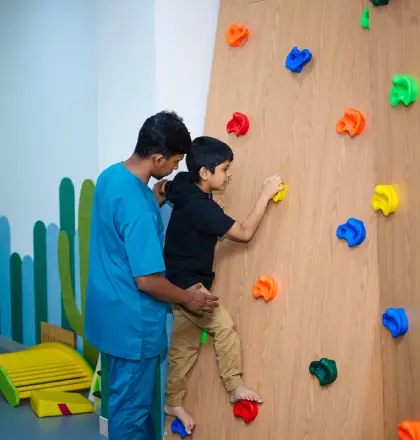
Who Do We Help?
Our occupational therapy services support:
- Children developing skills for daily living, play, school, and social participation
- Adolescents with developmental delays, sensory processing challenges, or executive functioning difficulties
- Adults recovering from injury, illness, or neurological conditions
- Individuals with neurological disorders such as stroke, brain injury or spinal cord injury
- Families and caregivers seeking strategies to support functional independence at home, school, or work
Services
Pediatric Occupational Therapy
Supporting children to develop functional skills for independence, learning, and social participation.
• Assessment of adaptive skills, fine and gross motor skills, sensory processing, cognitive development, and school readiness
• Support for autism, ADHD, developmental delays, and related challenges
• Interventions for communication, social skills, sensory integration, and executive functioning
• Play-based, structured, goal-oriented therapy with parent guidance and school collaboration
Adult Occupational Therapy
Helping adults regain independence and confidence after injury, illness, or neurological conditions.
• Rehabilitation for stroke, brain injury, spinal cord injury, and post-surgical recovery
• Pain management, joint protection, and mobility support
• Hand and upper limb rehabilitation
• Cognitive retraining for attention, memory, and executive function
• Training in daily living activities, work tasks, and adaptive strategies
• Use of assistive devices, task simplification, and return-to-work support
Our Team

Ms. Neetu Bala (BOT)
Occupational Therapist

Mr. Julio Joseph (BOT)
Occupational Therapist

Ms. Alveena Treesa Ouseph (BOT)
Occupational Therapist
FAQ's
OT helps individuals perform daily activities independently, safely, and efficiently, promoting functional living across home, school, and work settings.
OT supports children in developing motor skills, daily routines, sensory processing, school readiness, and social participation.
Yes. OT helps adults regain independence in self-care, mobility, work, and leisure activities.
Absolutely. Family involvement is key to reinforcing skills at home and school.
Yes. OT includes assessment and training in adaptive tools to maximize independence and safety.
Occupational therapy for autism is a structured, evidence-based intervention that helps children build independence in daily tasks, handle sensory challenges, develop motor skills, and engage more confidently in social settings. Every programme is built around the individual child's profile rather than a generic template.
Children as young as 18 months can begin OT if early signs of developmental delay or sensory difficulty are present. That said, it is never too late to start. Children of any age make progress when the therapy is suited to their needs and consistently attended.
The number of sessions depends on the child's diagnosis, the areas being addressed, and how regularly they attend. Most children with autism attend multiple times each week over several months, with periodic reviews to assess progress and refine the plan.
Occupational therapy is one of the most well-supported interventions available for children with autism. Consistent therapy, personalised to the child and backed by active parent involvement, leads to benefits in sensory regulation, motor skills, daily living independence, and social confidence.
Jeevaniyam Medipolis is recognised as one of the best occupational therapy centres in Kochi. The combination of a multidisciplinary clinical team, purpose-built therapy spaces, and a genuinely child-centred approach makes it a centre that families trust for both the quality of care and the consistency of results.
Occupational Therapy for Autism in Kochi, Kerala
Occupational therapy holds an important role among integrated therapies. It is an allied health profession that involves the therapeutic use of everyday activities, or occupations, to treat the physical, mental, developmental, and emotional ailments that affect a person’s ability to perform day-to-day tasks. OT is useful in many diseases and conditions. Jeevaniyam is the best occupational therapy centre in Kochi, Kerala. Special children are one main group that gets benefits from therapies under the department of OT. Most common occupational therapy interventions include helping children with disabilities to participate fully in school and social situations, helping people recovering from injury to regain skills and providing needed support. Occupational therapy services typically include:
- Individual evaluation, during which the client, family & occupational therapist determine the person’s goals.
- Customized intervention to improve the person’s ability to perform daily activities and attain the goals.
- Evaluation to assess the improvement and/or make changes to the intervention plan.
At Jeevaniyam Medipolis, our department of OT holds prime importance in helping special children become self-reliant. Our professionals in OT train the children in a very caring and customised way. Each child receives proper guidance and support with utmost love and patience. With the physician, parents and trainers working as a team, the child can improve very fast and start learning new things in an easier way. In the department of occupational therapy, we train the differently abled children to cope up with their family, school and other public places. This helps them to be a better part of their social environment. This target is achieved by personalized & continuous training to improve attention, sitting behavior, activities of daily life, gross motor skills, fine motor skills, balance of the child. Jeevaniym provides the best occupational therapy for autism in Kochi, Kerala.
Why Choose an Occupational Therapy Centre in Kochi?
Consistency is what holds a therapy programme together. For families, choosing an occupational therapy centre in Kochi, Kerala, reduces the long drives, the late arrivals, and the cancelled sessions that slow down progress. Children with autism, cerebral palsy, or sensory processing challenges cannot afford these interruptions. A centre that is accessible enables parents to follow through, children to show up prepared, and the sessions to build on. The right occupational therapy centre in Kochi has therapists who are trained and experienced with paediatric cases, and a physical space that a child with sensory sensitivities does not find threatening the moment they walk in. Beyond that, parent involvement changes everything. What a child practises in a session needs to be practised at home, school, during mealtimes and bedtime. Centres that take time to coach families on how to reinforce progress outside of sessions are known to produce outcomes.
Jeevaniyam Medipolis is one of the leading occupational therapy centre in Kochi that has dedicated therapy rooms, a sensory integration space, and assessment areas designed around children with varied developmental needs. Our occupational therapists here work with developmental pediatricians, speech language pathologists, and behaviour specialists. This coordinated structure makes a difference for children whose needs extend across multiple areas of development.
How Occupational Therapy Helps Children with Autism
Occupational therapy for autism is not about teaching children to sit still or follow instructions. It is about understanding why certain environments, sensations, and social situations are genuinely difficult for a child and then building the skills and tolerances that make daily life more manageable. Sensory processing is where most autistic children struggle. Sounds that others filter out, fabrics that feel unbearable, and lights that are physically distracting are neurological responses. Sensory integration therapy works by gradually exposing children to these inputs in a controlled environment. This helps the nervous system learn to process them. Most families notice real change in emotional regulation and overall calmness within a few months of regular sessions.
Play-based therapy and ABA-integrated occupational therapy are also key parts of the care approach at Jeevaniyam. For younger children, structured play is one of the best learning environments because it is not overwhelming. Sounds that others ignore, fabrics that feel uncomfortable, or lights that are distracting are neurological responses. Sensory integration therapy helps children by gradually exposing them to these inputs in a safe setting. This process allows the nervous system to learn how to handle these sensations. Most families see real changes in emotional control and overall calmness within a few months of regular sessions.
Our Occupational Therapy Process at Jeevaniyam
Therapy works best when it follows a clear structure that both the family and the child understand. At Jeevaniyam Medipolis, every child goes through four defined stages. Each stage is designed to build on the one before it, so nothing is rushed and nothing is skipped.
Initial Assessment
Before anything else, therapists take time to understand the child’s strengths, their specific challenges, their sensory profile, and how they currently function in daily life. This assessment forms the entire foundation of what comes next.
Goal Setting
Therapists, parents, and, when appropriate, the child work together to set goals. These goals focus on practical outcomes that can make a positive difference in the child's everyday experiences.
Personalised Therapy Plan
Using the assessment and agreed goals, our therapists build a programme specific to that child. Some children need intensive sensory integration work. Others need fine motor development, ABA-combined sessions, or play-based activities. Often it is a combination, adjusted as the child progresses.
Progress Monitoring and Reviews
Plans are revised based on the child’s development. Therapists share honest updates with parents, track progress against the original goals, and adjust the programme when something is not working or when the child is ready to move forward.
Conditions We Treat Through Occupational Therapy
The occupational therapy team at Jeevaniyam Medipolis works with children across a range of developmental and neurological conditions. Each condition is approached with the same level of care and clinical attention, regardless of severity. These include:
- Autism Spectrum Disorder (ASD)
- Attention Deficit Hyperactivity Disorder (ADHD)
- Cerebral Palsy, Developmental Delays
- Sensory Processing Disorder
- Down Syndrome
- Learning Disabilities
No two children with the same diagnosis present in the same way. Every therapy programme is built from the child's individual assessment and adjusted according to the child’s needs.
Signs Your Child May Benefit from Occupational Therapy
Most parents notice something is off long before a diagnosis is made. It is rarely one big moment. Instead, it’s usually a quiet accumulation of small things that do not quite add up. These patterns are worth paying attention to:
Difficulty With Hand Control Tasks
Tasks like holding a pencil, buttoning clothes, or using a spoon seem much harder for your child compared to others their age. These are not just awkward moments because they happen often enough that you begin to notice a pattern. Other children the same age seem to handle these tasks easily, and the gap is growing harder to ignore.
Short Attention Span or Persistent Restlessness
Sitting through a meal or a brief classroom activity feels like a real struggle for them. This isn't occasional, as it happens most of the time, noticeably more than what other children their age find difficult. Teachers may have mentioned it, or you may have noticed it long before anyone else.
Strong Reactions to Everyday Sensory Input
Certain sounds, fabrics, lighting, or unexpected touches cause a distress that surprises you. Other children around them do not seem to react in the same way, and calming them down afterwards takes much more time and effort than it should. These reactions are consistent, not random.
Struggles in Social Situations
Engaging in group play, taking turns, or simply being around other children consistently feels hard for them. They are not just going through a shy phase. Social situations genuinely seem overwhelming rather than simply unfamiliar. Over time, they may start to avoid group settings altogether instead of pushing through the discomfort.
Delayed Self-Care Milestones
Getting dressed, handling toileting, or eating independently are things your child still finds challenging at an age when most children have already mastered them with little help. It is not about being slow; these everyday tasks require physical coordination or focus that does not come easily to them yet. If several of these feel familiar, an early assessment at a child development centre in Kochi, Kerala is worth pursuing. The sooner occupational therapy begins, the better the outcomes tend to be.

